
Thoughts and Aimless Ramblings
I’m sure you’ve heard people say that Italian wines are “better with food”. It wouldn’t be fair to paint them all with the same brush as there are so many types and styles of Italian wine. If you spend $15 on an Australian red you almost can’t go wrong but the story with the Italians is not that short.
Sadly, you can spend well over $30 on an Italian and be disappointed. A good example would be the neophyte popping beaucoup bucks on a Barolo, the King of Italian wines, and getting caught off guard by the explosion of grippy tannin that defines that wine. Still, a bad impression of Italian wines in general would be undeserved. People often sell Italian wines short after a few underwhelming experiences; a complete tragedy. The facts of the matter are that Italian wines are made in a dizzying array of styles but it’s pretty easy to make a wrong choice if you’re uninformed. There’s lots of science behind acidity and tannin levels and, like most things, different wines suit different tastes.
There’s definitely lots to learn about Italian wines and you may be asking yourself “why bother?” The answer is simple, when the stars align in your universe it can change your life! I hope you have that epiphany and will join me on the dark side of Italian wines.
Italian Wine Classification
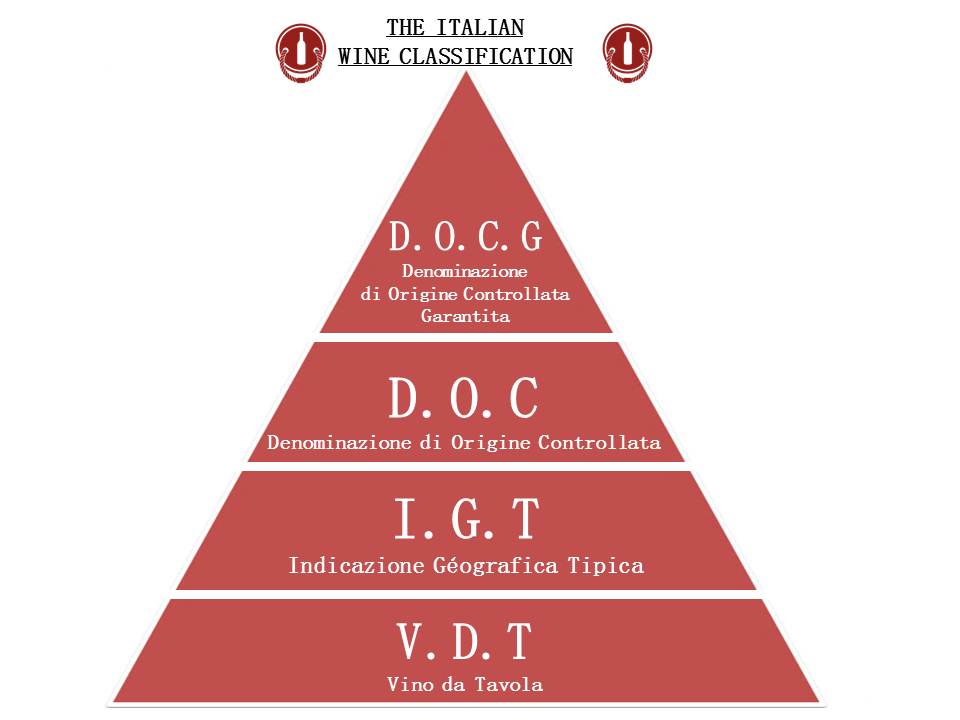
The best wines have the top classification of D.O.C.G, followed by D.O.C and then I.G.T. The bottom classification, V.D.T is used for table wine that is not generally for export. An Italian wine’s classification can be found on the neck of the bottle.


You will often see the term Riserva on a label which just means a longer time in the cask before the wine is released.
Notable exceptions to this yumminess scale are the Super Tuscans and the Bordeaux style blends from Tuscany that fall outside of the restrictive D.O.C.G / D.O.C rules and by law must be labeled I.G.T. Although they don’t have the prestige of a D.O.C.G classification, many easily hold their own against them.
The name of the particular D.O.C.G / D.O.C / I.G.T will always be on label as you see in the examples below:
Brunello di Montalcino D.O.C.G

Rosso di Montalcino D.O.C

You are probably wondering what all this classification stuff distills down to right? Quite simply, the DOCG / DOC / IGT system just helps us make a good choice on what wine to try next. If you like a Chianti Classico D.O.C.G wine, then you can be assured that any Chianti Classico D.O.C.G wine you buy will reflect a similar taste profile. A Chianti Classico D.O.C.G, a Barolo D.O.C.G and an Amarone della Valpolicella D.O.C.G will all reflect their own taste profiles.
The Italian D.O.C.G / D.O.C and the French AOC system is far more meaningful than the American AVA and Canadian VQA. Lots of American and Canadian wine fanboys will vehemently disagree with this but just consider the facts. The North American classification systems do not regulate :
Grape Varieties – allowable grapes and percentages of each in a blend
Production Standards – density of vineyards, yield per acre, irrigation rules, mandatory “triage” (discard imperfect grapes), mandatory discard (eg. 2% of all harvests must be discarded in Châteauneuf-du-Pape AOC)
Vinification Standards – amount of time before release, amount of time in cask , minimum alcohol levels , chaptalization (adding sugar to a wine) etc.
Summary Italian Wine Classification System
Since the system is so detailed in regulating production standards, vinification standards , allowable grap varieties , it is very handy for the consumer to make educated decision on purchase of a bottle of Italian Vino.
Of course you need to figure out what you like to start off with first, since Italy offers a diverse style of wine for every budget … so get drinking !
 Barley and Vine
One Comment Add yours